AURORA DESIGN STUDIOSNARRATIVE ARCHITECTURE · BOOKS · SCRIPTS · WORLDS Contact

IMAGINE.
ARCHITECT.
ENDURE.

WAR OF FEATHER AND CHITIN

War of Feather and Chitin

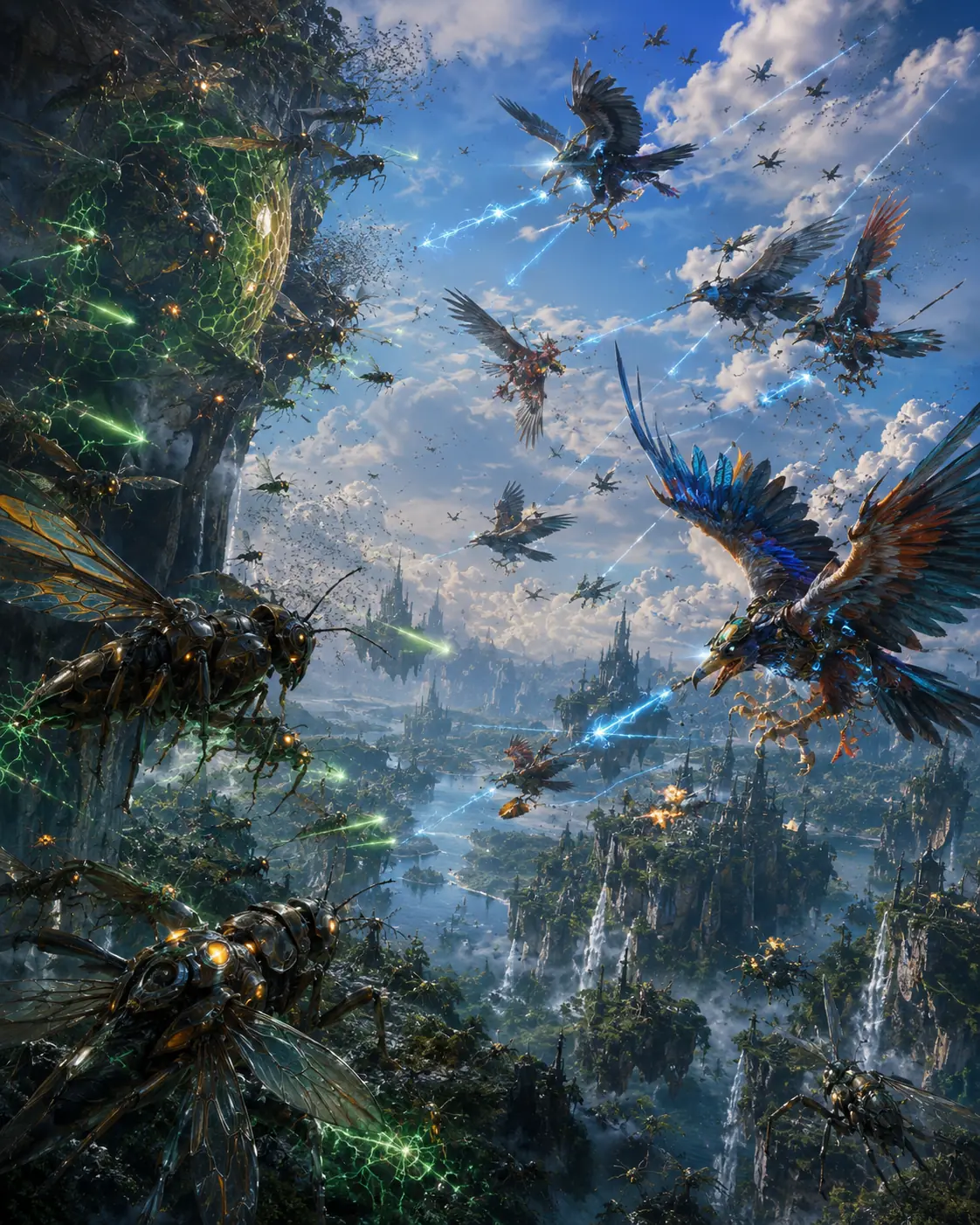
SkyHive’s defining conflict grows from two advanced civilizations competing across open sky, living towers, deep canopy, and subterranean infrastructure. It is not human warfare with feathers and chitin added; anatomy, scale, ecology, and three-dimensional geography change every decision.

PRELIMINARY · content and parameters remain subject to canon/science review.

The conflict system

War in a world without a flat front.

Avian and arthropod forces can achieve comparable strategic power without sharing the same bodies, tools, command structures, or definitions of defensible territory.

Weapons are classified as plausible, extrapolated, or reserve. FTL effects, gravity manipulation, magical shields, and indiscriminate superweapons remain outside active canon unless separately reviewed and approved.
Vertical battlespace

There is no single front line.

Conflict can pass above a storm deck, through an inhabited spire, across a canopy transport web, and into a buried arthropod service city during the same operation. Altitude is not merely higher ground: it affects energy, visibility, temperature, atmospheric density, endurance, communications, and the time available to recover from mechanical failure.

Avian forces range from smaller scouts and technicians to powerful, ostrich-scale fliers adapted to SkyHive’s reduced gravity and dense air. Their size gives them reach, endurance, and payload capacity, but it also increases turning radius, landing requirements, heat load, and vulnerability in confined spaces. Their equipment therefore grows from aerodynamics and precision rather than from decorative armor.

Arthropod forces are equally technological. Specialized bodies operate tools, fabrication systems, sensor networks, climbing equipment, and defensive platforms designed around exoskeletal strength and collective maintenance. Coordination does not make them mindless. Individuals interpret information, exercise judgment, and serve within political institutions whose orders can be disputed, delayed, or refused.

AltitudeWeatherLogisticsVertical citiesLiving infrastructureCivilian protection

Consequences

Every victory changes the shared world.

The war matters because neither civilization can isolate itself from the biosphere or from the infrastructure that keeps both societies alive.

Infrastructure is terrain

Sky lanes, lift towers, water systems, pollination corridors, thermal shafts, tunnels, and power relays are military objectives and civilian lifelines at the same time. Capturing them may be strategically useful; destroying them can create famine, atmospheric imbalance, or regional collapse long after the fighting ends.

Intelligence has limits

Each civilization senses the world differently. Avian observers dominate long-range visual and aerial reconnaissance, while arthropod networks integrate chemical, vibrational, local sensor, and distributed maintenance data. Neither side receives a perfect picture. Misread signals and incompatible assumptions can turn a defensive movement into an apparent attack.

Survival requires restraint

The deeper story is not an endless war. It is the difficult recognition that total victory would damage the planet both peoples inherit. Protected habitats, evacuation corridors, arms limits, shared disaster response, and eventually interoperable warning systems become as important as any weapon or celebrated commander.