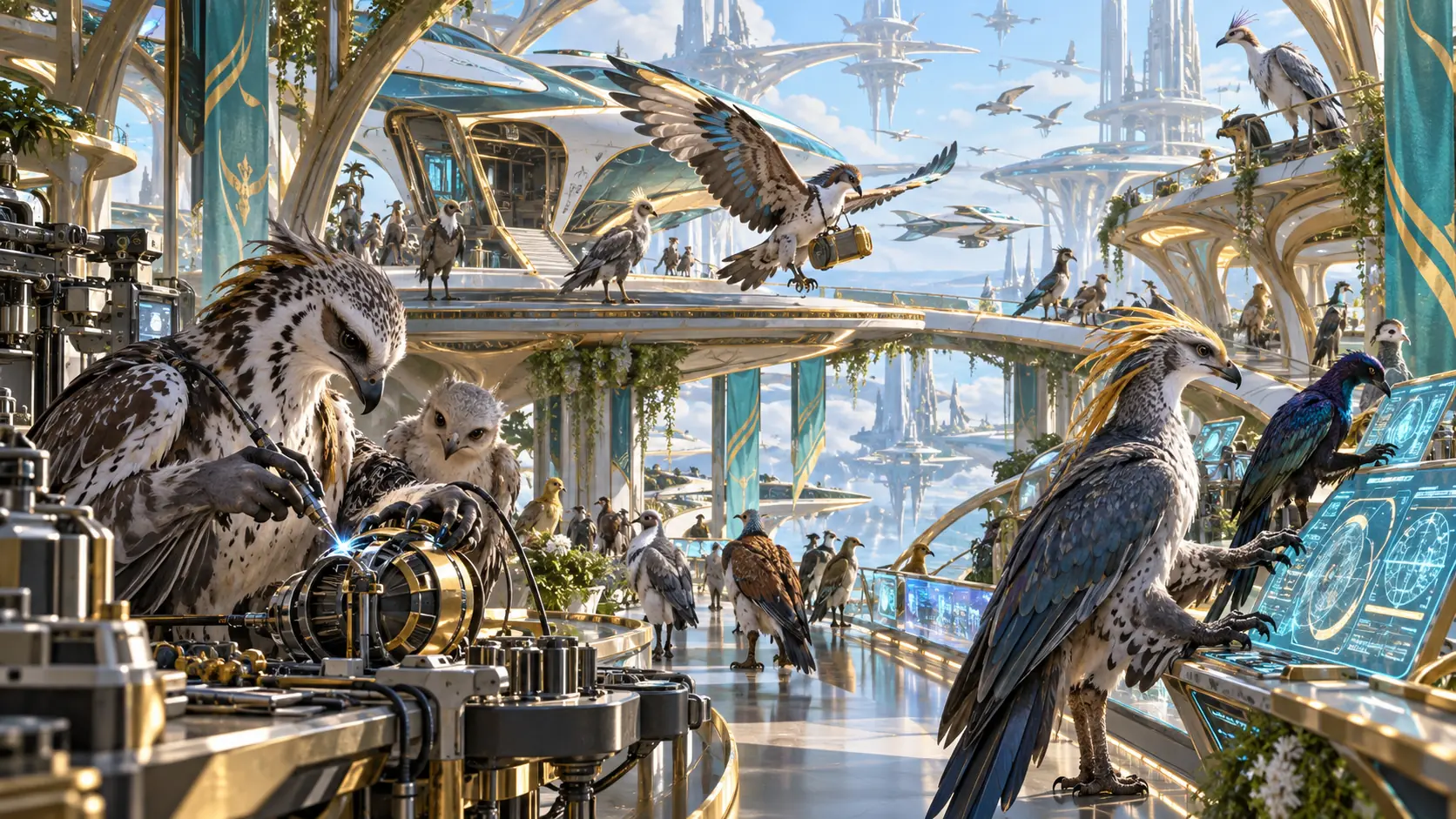
Manipulation without human hands
Dexterous feet, specialized beak structures, flexible tongues, wing-associated control surfaces, wearable manipulators, and purpose-built fixtures form a complete tool ecosystem. Complex work is divided between direct biological control and instruments that stabilize, magnify, or translate movement. Workshops, laboratories, vehicles, and domestic spaces are designed around perching, bracing, suspended access, and multiple working heights rather than copied human furniture.
Large bodies that still fly
The lineage includes different sizes and flight strategies. Some adults may approach the mass and standing height of terrestrial ostriches while remaining capable of powered flight because SkyHive combines lower gravity with denser air. Larger individuals require broader wings, stronger launch structures, longer turning space, and careful heat management. Size therefore affects occupation, architecture, transport, military roles, and status without dividing the species into simplistic fantasy classes.
Individuals within a complex society
Flock behavior is an evolutionary starting point, not a hive mind. Avian citizens possess individual identity, family attachments, professions, beliefs, ambitions, and political disagreements. Vocal language, body posture, feather display, written or visual records, and electronic systems carry different kinds of meaning. Their governments contain competing regions and institutions, while science, art, education, commerce, law, and dissent demonstrate a civilization as internally varied as any human one. Accessibility also matters: injured, elderly, juvenile, or ground-bound citizens require lifts, secure walkways, public transport, and tools that do not assume effortless flight.