AURORA DESIGN STUDIOSNARRATIVE ARCHITECTURE · BOOKS · SCRIPTS · WORLDS Contact

IMAGINE.
ARCHITECT.
ENDURE.

ARTHROPOD LINEAGE & CIVILIZATION

Arthropod Conclave

An advanced technological civilization shaped by distributed cognition, specialized bodies, biological industry, and living infrastructure—not an enlarged insect colony.

PRELIMINARY · content and parameters remain subject to canon/science review.

Civilization from biology

Five systems behind the Conclave.

Body structure and respiration establish the limits; cognition, coordinated settlements, and specialization turn those limits into a distinct technological society.

Arthropod design anchors

Advanced people—not giant insects.

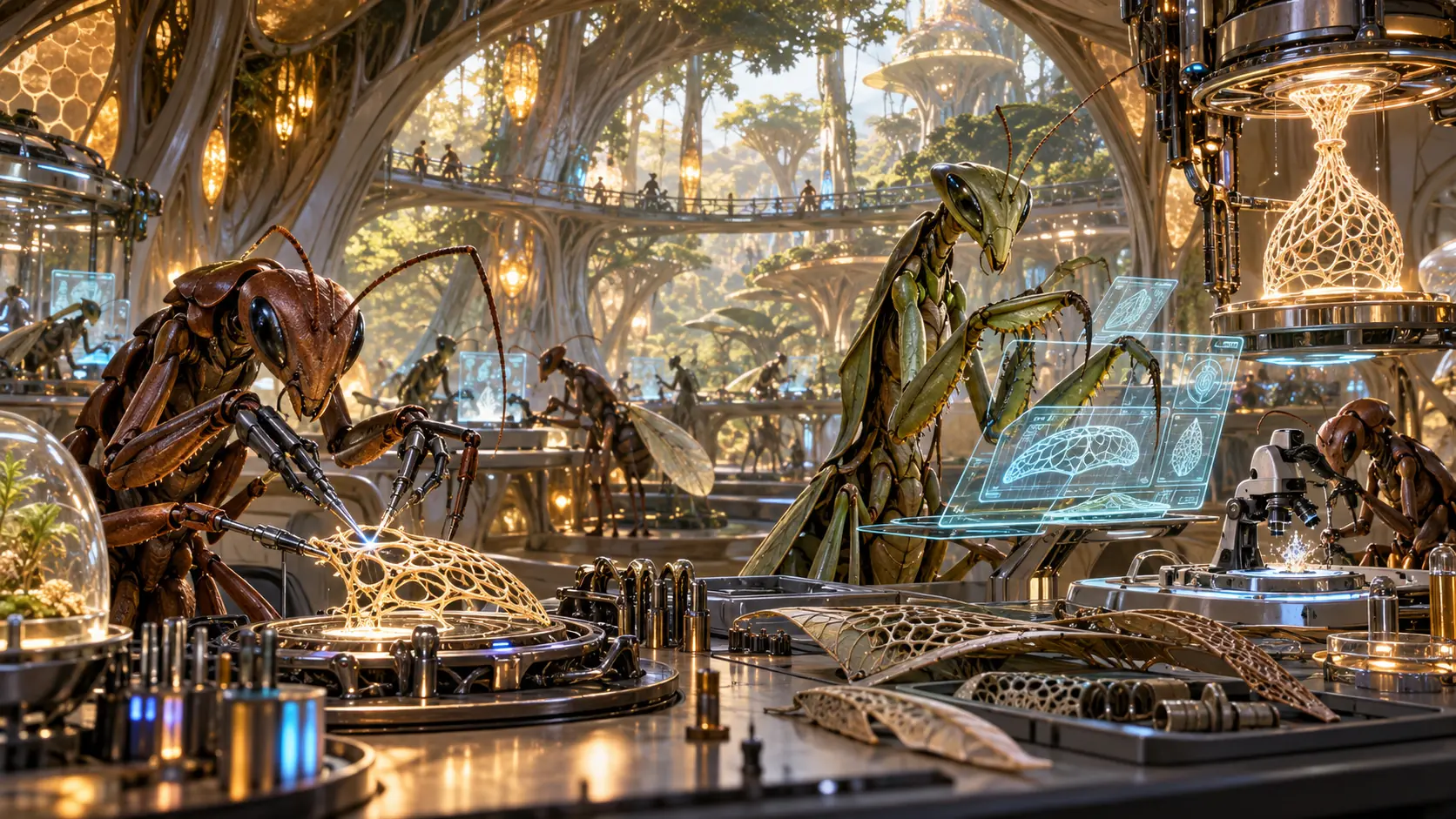
The Conclave develops through the interaction of plausible large-body biology and accumulated civilization: active respiration, composite structures, chemical and gestural language, distributed cognition, precision tools, biofabrication, and infrastructure maintained across generations.

Daily life makes their personhood unmistakable. Individuals receive education, choose specialties within biological limits, maintain households, form durable relationships, pursue research, exchange goods, create sensory art, and participate in civic disputes. Medicine addresses exoskeletal damage, molting, respiration, infection, and neural stress. Public systems accommodate different body plans and developmental stages. Their civilization is alien in its interfaces and social rhythms, yet recognizable through care, responsibility, curiosity, ambition, humor, and disagreement. Names, reputation, authorship, property, testimony, consent, and accountability attach to individuals even when work is performed through tightly coordinated groups.

Active ventilationComposite exoskeletonDistributed cognitionPrecision toolsBiofabricationLiving infrastructure
Conclave civilization

Coordination does not erase individuality.

The Conclave is built from alien anatomy and communication, but its members remain reasoning people rather than interchangeable workers in an oversized colony.

Bodies engineered by evolution

Large arthropod sophonts require more than abundant oxygen. Active respiratory pumping, efficient internal circulation, composite exoskeletal materials, segmented load paths, controlled molting, and thermal regulation work together. Specialized limbs provide locomotion, anchoring, sensing, and precise manipulation. Their tools and buildings begin with these capabilities instead of forcing an insect-shaped body into equipment designed for a human operator.

Distributed but personal intelligence

Chemical signals, vibration, posture, touch, sound, and electronic translation can operate simultaneously, giving Conclave communication unusual density. Shared networks preserve technical knowledge and coordinate large projects, but they do not replace personal judgment. Citizens can disagree with policy, refuse orders, change occupations, form relationships, create art, conduct research, and belong to rival schools of thought. Collective capacity and individual agency coexist.

Industry becomes living infrastructure

Arthropod engineering favors cultivated materials, modular repair, chemical processing, environmental sensing, and systems maintained by many specialists. A city may grow structural layers while still using machines, computation, standards, and formal inspection. Developmental castes are not social destiny: institutions determine training, authority, mobility, and rights. The resulting civilization is technologically sophisticated, politically contested, and capable of both extraordinary continuity and catastrophic error.