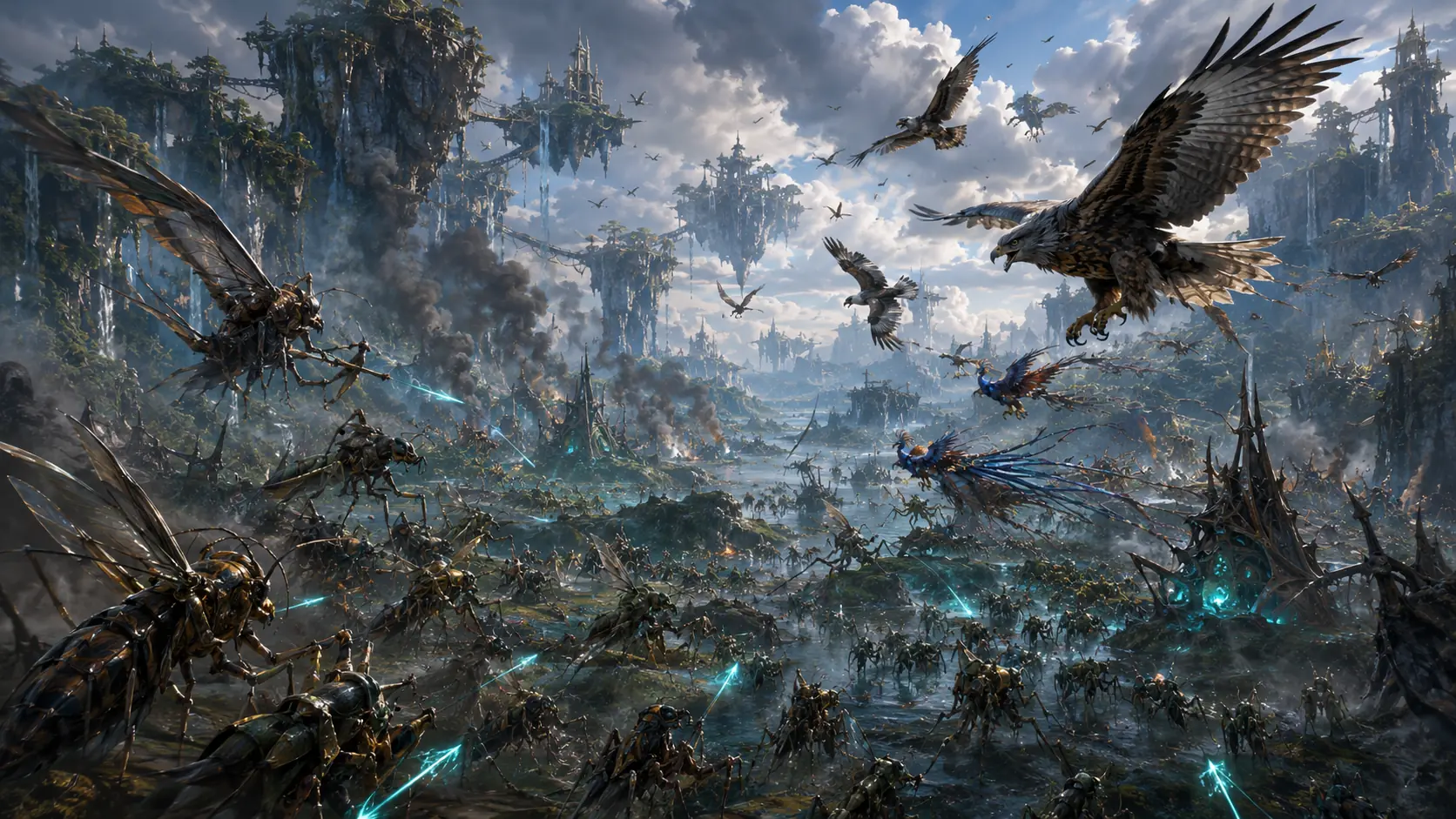
Deep-time frame
Ecology becomes memory, law, and myth.
The oldest predator–prey relationship survives only indirectly. Evolution leaves reflexes, sensory priorities, body plans, threat responses, and inherited ecological roles—not a literal racial memory. Later cultures interpret those biological traces through story, education, religion, politics, and propaganda. The result is powerful, but never simple: ancient ecology is repeatedly rewritten to justify present choices.
Ecological divergenceDistinct aerial and arthropod lineages occupy different layers of a vertical biosphere and exert sustained evolutionary pressure on one another.
Cognitive transitionLearning, communication, planning, tool use, and intergenerational culture expand along separate anatomical pathways.
Engineered habitatsNests, galleries, cultivated flora, water control, transport routes, and protected workshops become permanent settlements.
Civilizational parityNeither lineage can permanently dominate; each develops science, industry, political institutions, and strategic depth.
Cycles of warConflicts, armistices, technical escalation, and selective cooperation accumulate into a shared but disputed historical record.
Shared survivalPlanetary systems and common hazards gradually force limited standards, protected corridors, and joint stewardship.