
Agriculture
NanoFeast changes farming; it does not erase the reasons farms exist.
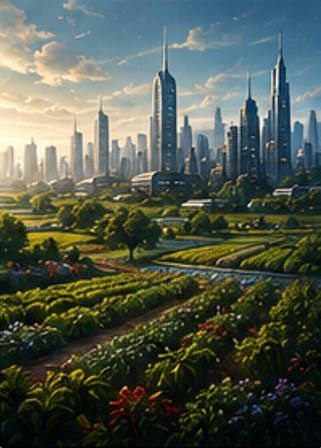
The strongest world architecture is hybrid: conventional agriculture, controlled-environment growing, local food production, ecological restoration, and replication support one another instead of collapsing into a single fragile system.
Conventional farms
Land stewardship, crops, livestock, seed diversity, regional knowledge, soil health, and rural economies remain important even when some food can be fabricated.
Controlled environments
Hydroponic, aeroponic, rooftop, warehouse, subterranean, greenhouse, and other protected systems can support fresh produce and regional resilience.
Water loops
Agriculture links directly to treatment, reuse, precision irrigation, drought planning, and local water security.
Resilience rule
NanoFeast is strongest when it reduces pressure on vulnerable supply chains without becoming the only way a population can eat.
Vertical farming helps where weather and soil fail—but it is not a universal replacement.
USDA describes controlled-environment agriculture as a growing family of systems that can reduce exposure to adverse weather and common pests, extend production seasons, and enable year-round fresh-produce production. Fully indoor vertical systems also bring real capital and energy costs.
Protected growing
Greenhouses, high tunnels, and indoor systems can buffer heat, storms, excess rain, drought, and seasonal limits for suitable crops.
Produce close to demand
Hydroponic and vertical systems can grow fresh produce where good soil or open land is scarce and can recirculate water efficiently.
Not every calorie belongs indoors
Leafy greens, herbs, tomatoes, cucumbers, and other high-value produce fit controlled environments better than many bulk staple crops. Field agriculture remains essential.
Power has to pencil out
Artificial lighting, HVAC, dehumidification, pumps, and controls can be expensive and energy intensive. Resilient CEA needs efficient equipment, appropriate crops, and reliable low-cost power.