Dark City: Homecoming
John Murdoch returns to a physically failing city where incomplete memories, divided survivors, and evidence that the Strangers may not be gone force a deeper question: is home the place they escaped from, the Earth they barely remember, or the society they choose to build together?
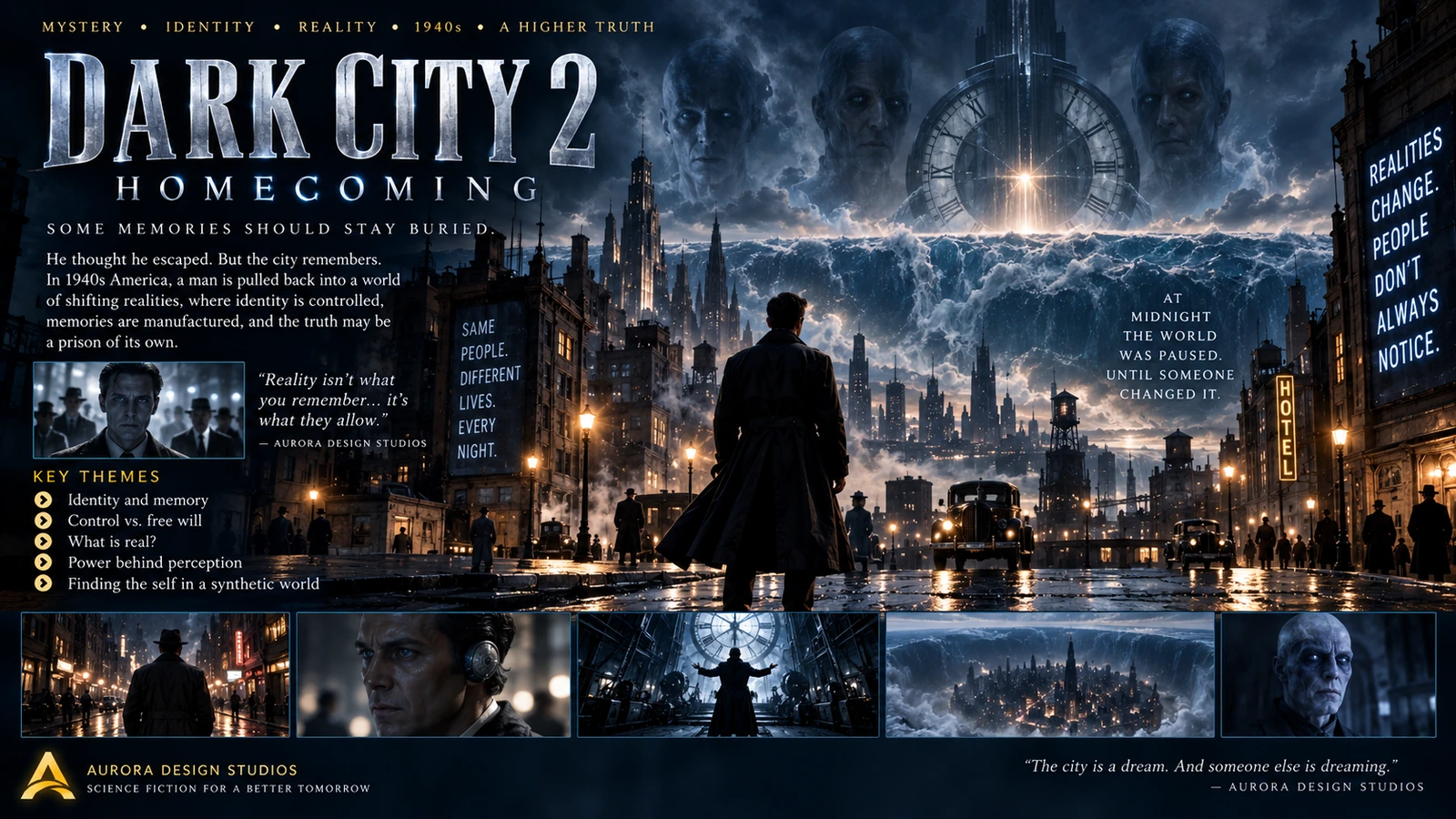
Continuity / Rights Control
The page family must preserve the screenplay's survival, identity, and civic architecture without treating generated marketing visuals as automatic canon.
Original-Film Continuity Anchor
Homecoming retains the original film’s mid-century / 1940s urban shell: period automobiles, streetlights, clothing, trains, apartments, hotels, docks, and noir interiors rather than flying cars or generic cyberpunk. The Strangers remain nonhuman parasites using human bodies, and their midnight clock-and-tuning machinery is part of the city’s control architecture. John begins from the victory state established at the end of the first story: he overpowered the Strangers’ tuning system, took control of the city’s reality-shaping machinery, and reshaped the artificial city to create the shoreline and ocean he remembered as Shell Beach. The sequel may expand the constructed world, but it should not visually erase that starting point.
Continuity Locks
- John Murdoch: lives inside the damaged city he once fought to control; his memories of Earth remain incomplete.
- Stay vs. search: survivors are genuinely divided between building a permanent home and risking the community to find Earth.
- Emma / Clara / Malcolm: Emma anchors the personal stakes; Clara's opposition is a legitimate political position; Malcolm's engineering makes daily survival concrete.
- Stranger pressure: Schreber's broken message suggests the Strangers are not truly gone, and Mr. Hand exploits division rather than functioning as a simple returning monster.
- Wider environment: settlement zones, forests, valleys, crystalline structures, encoded messages, and a deeper network expand the world beyond the old city.
- Ending direction: the crystalline entity reveals a larger survival cycle; the principal survivors choose movement and depart aboard a shard-powered vessel toward a distant alien structure.
Human Architecture
Future book development should make families, governance, markets, education, resource shortages, maintenance, law, and ordinary life visible. The society must feel lived in, not merely like a noir set between action sequences.
Rights-Safe Handling
- No claim of ownership, authorization, affiliation, or endorsement.
- Commercial exploitation requires permission from the applicable rights holder.
- Full screenplay material remains controlled.
- Generated visual-development art supports presentation and does not independently alter screenplay canon.
QC lock: source title page omits “2.” Use Dark City: Homecoming on the daughter-page family; retain the existing dark-city-2/ route to avoid breaking links.