Dogma 2: Divine Intervention
Bethany’s daughter Cassia is pulled into a new celestial crisis when reality around Newark begins to fracture, forcing a physician trained to diagnose the observable to defend her autonomy against institutions—human and divine—that insist on deciding what she means.
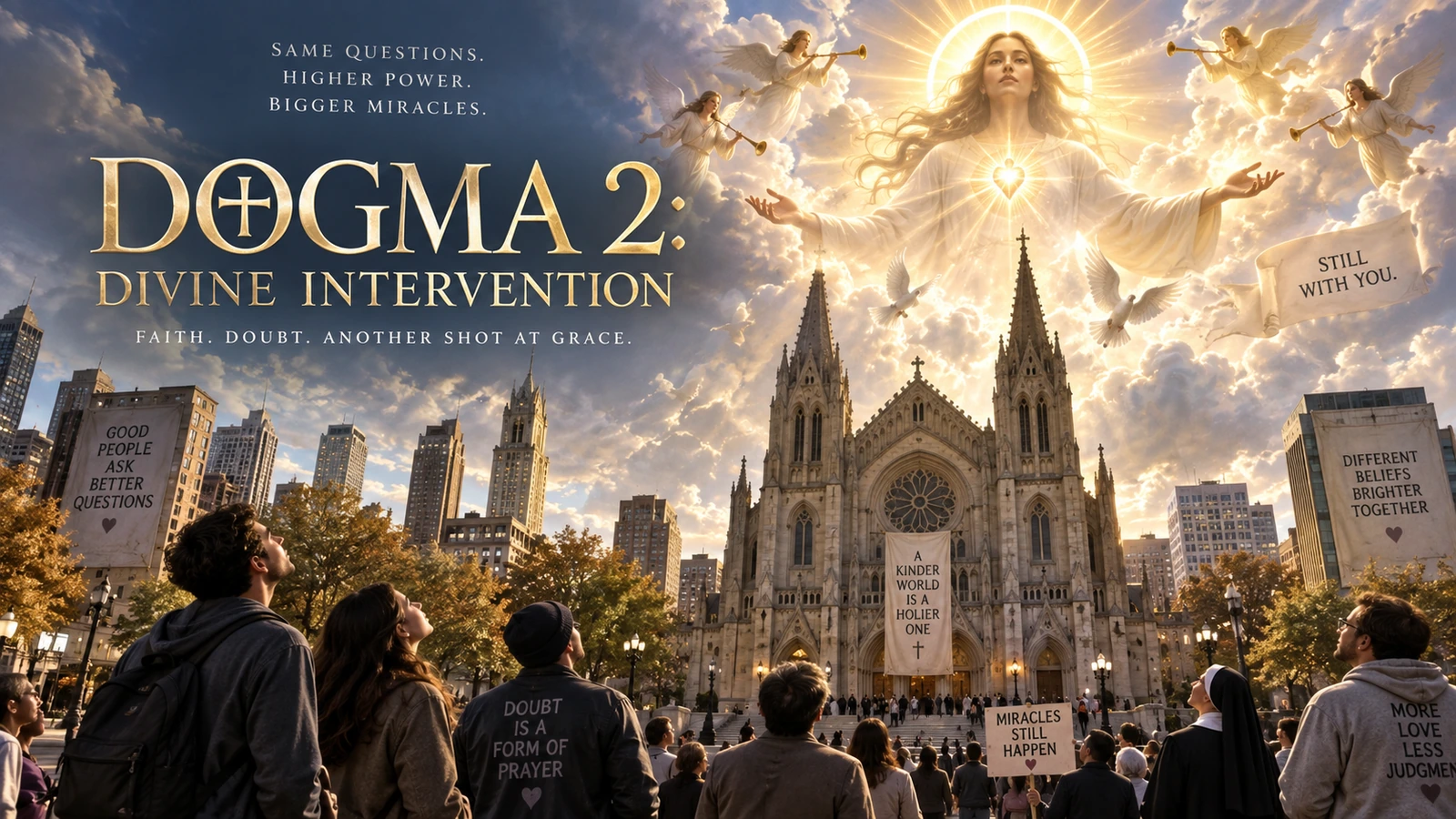
Core Hook
Bethany has tried to live beyond prophecy. Her daughter Cassia approaches extraordinary events as a physician—through observation, diagnosis, and care—until Newark itself begins behaving as though reality is being rewritten.
Source-Grounded Story Engine
Static-like entities, impossible hospital-system behavior, resonant medical instruments, celestial factions, the Lazarus Protocol, the Choir, and corrupted security systems place Cassia between family history and institutions that want to assign her a role.
Development Status
Primary source: Dogma 2 - Divine Interventions Script Final.pdf. Scale: 121 pages. Source status: primary lock with document-QC issues tracked privately.
Public Overview
Dogma 2: Divine Intervention moves the center of the continuation to the next generation. Bethany is older and has spent years living with the consequences of being the Last Scion. Her daughter Cassia works in medicine and meets the world through evidence, diagnosis, and practical care rather than prophecy. That distinction becomes impossible to maintain when reality around Newark begins to fracture. Static-like entities appear, hospital systems behave as if they are being rewritten, and Cassia’s stethoscope resonates with impossible harmonics.
Bethany brings memory and maternal fear to the crisis. Metatron and Rufus provide different forms of cosmic and human perspective, while JoJo becomes a contemporary witness whose instinct to document events through digital media turns faith into a public, algorithm-driven spectacle. Dev, Naomiel, and Sandalphon occupy different positions inside the larger celestial conflict. Sandalphon’s anger grows from the belief that mortals repeat the same failures; Naomiel represents a colder doctrine of order and correction.
The strongest adaptation lane is the mother-daughter relationship. Cassia does not need to become a conventional chosen-one heroine. Her conflict is whether she can remain a physician, daughter, citizen, and autonomous person while celestial powers, institutions, media, and frightened communities project meaning onto her. Medicine becomes a useful counterpoint to miracle: Cassia listens, observes, treats, and tries to help before she interprets.
The screenplay resolves with Newark battered but alive. Cassia rejects ownership by heaven or any other authority, Bethany grounds identity in family rather than prophecy, and Rufus reframes faith as lived choice instead of institutional permission. The development path therefore keeps the comedy and theological argument, but anchors them in agency, family, care, and the consequences of systems that confuse authority with moral certainty.
Rights boundary: Independent speculative continuation of pre-existing third-party IP. Aurora Design Studios claims no ownership, affiliation, endorsement, or authorization. Commercial book, film, television, or derivative use requires permission from the applicable rights holder. Rights-holder identity is not asserted on this page unless separately verified.