Idiocracy: Rise of the Average
Continuity control preserves the current title, Smart-Stop/Brain Trust architecture, the anti-caste thematic rule, and explicit source discrepancies while keeping the full approved artwork visible.
Title Lock
Idiocracy: Rise of the Average. The Smartening is development history, not a competing public title.
Technology Lock
Smart-Stop 2.0/3.0, Emergency Dumb Mode, Resonator X1, satellite delivery, cognitive suppression/restoration concepts, frozen scientists, corporate AI and attention systems remain the core technology/lore lane.
Theme Lock
Education and critical thought are civic capacities. The solution cannot become a new caste system in which “smart people” simply inherit authority.
Continuity / QC Controls
- Preserve the current Rise of the Average title.
- Keep the 104-vs-109 page discrepancy explicit.
- Treat the older ~170-page Phase 2 draft as non-current authority.
- Do not reopen later experimental title/story branches unless deliberately approved.
- Carry earlier midpoint, All-Is-Lost, transition, and ending notes forward as revision tasks only.
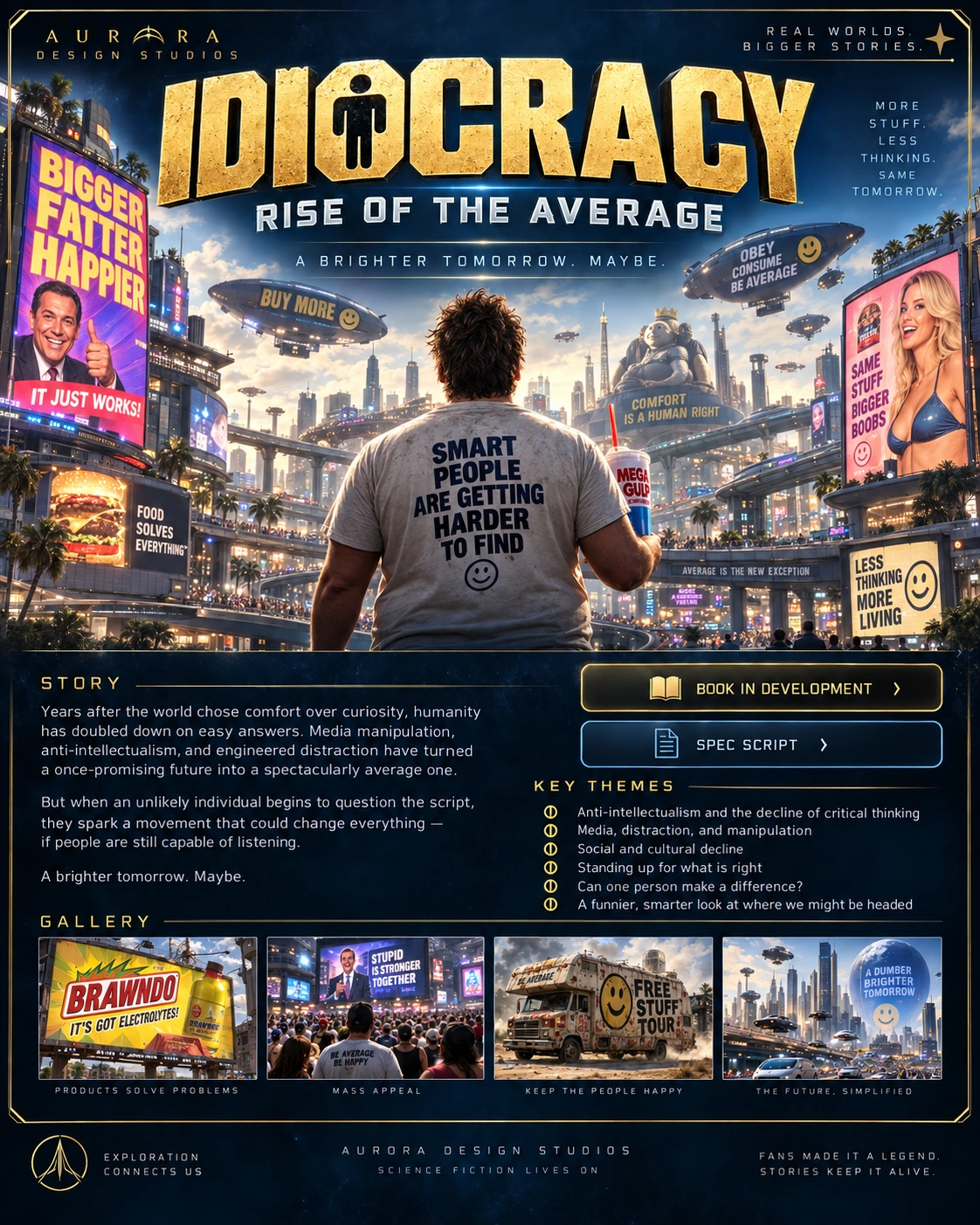
Visual Continuity
The complete artwork is intentionally shown without zoom/crop so the daughter page preserves the same conceptual world visible on the parent card.
Rights boundary: Independent speculative continuation based on pre-existing third-party IP. Aurora Design Studios claims no ownership, affiliation, endorsement, or authorization. Commercial book, film, television, or other derivative use requires permission from the applicable rights holder.