Forbidden Planet: Fall of the Krell
A prequel about the Krell at their height: a civilization that perfected technology before it fully understood the minds controlling it.
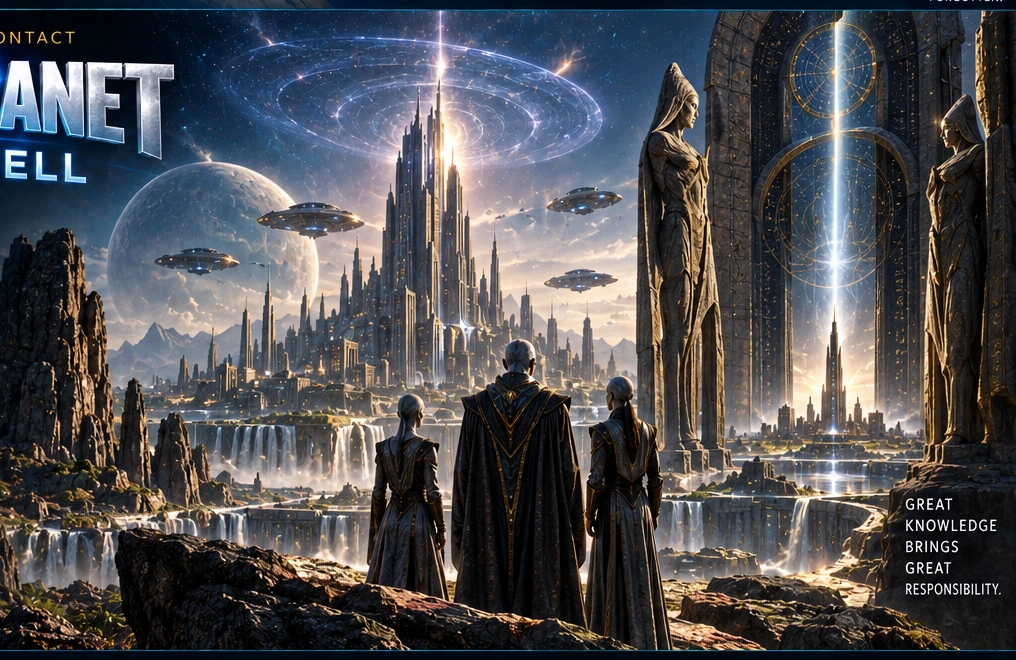
Act I — Ascension
The Krell are shown at their height: planetary mastery, energy abundance, AI and automation, education, art, family life, philosophy, government, science councils, and thought-responsive systems becoming ordinary infrastructure.
Act II — Threshold
Dream manifestations, psychological anomalies, scientific warnings, political factions, militarization debates, denial, and dependence on mind-reactive systems reveal a civilization whose technical capability is moving faster than its ability to govern itself.
Act III — Collapse Initiation
Subconscious amplification becomes catastrophic. Invisible attacks, reality distortions, mass fear, political fragmentation, and failing containment force the Krell to recognize the unbearable truth: their own minds have become part of the weapon.
Source-Grounded Overview
Core creative lock: the Krell achieved technological perfection before achieving psychological maturity.
Fall of the Krell is now presented publicly as a prequel centered on the civilization itself. The dramatic question is not how a brilliant people suddenly became foolish; it is how an extraordinarily advanced, culturally rich, scientifically disciplined civilization could build systems that amplified capabilities faster than it learned to govern fear, ambition, status, grief, desire, and unconscious conflict.
The story therefore begins in a functioning society rather than in ruins. Families live inside abundance. Children learn history and science. Artists, engineers, philosophers, political leaders, educators, researchers, and ordinary citizens inhabit a world where planetary engineering and thought-responsive infrastructure have become normal. This human-scale—or Krell-scale—civilization texture is essential because the collapse matters only if the audience first understands what is being lost.
The technology is not evil by itself. The Plastic Educator lineage, Consciousness Engine, planetary neural lattice, gateways, adaptive architecture, advanced energy systems, conscious vessels, and archive technologies all arise from genuine achievement. The tragedy begins when mind-reactive systems make the old separation between psychology and infrastructure increasingly impossible to maintain.
Book I is designed to end near the first irreversible global cascade rather than compressing the entire extinction of the Krell into one volume. That gives the fall time to become social, familial, political, scientific, and moral—not merely spectacular.
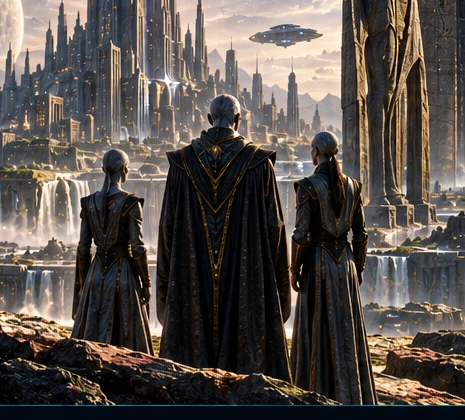
Civilization Before Catastrophe
Daily life remains visible beside technology: family, education, work, governance, law, media, public opinion, art, belief, recreation, class and post-scarcity tensions, scientific prestige, grief, and ordinary disagreement.
Source-control note: The expanded screenplay remains a protected development reservoir. The current book architecture deliberately reorganizes that material into a Krell-civilization prequel; screenplay material that belongs to later human-era continuity is not silently presented as if it were already part of the prequel novel.
Rights boundary: Independent speculative prequel development based on pre-existing third-party IP. Aurora Design Studios claims no ownership, affiliation, endorsement, or authorization. Commercial publication, film/television production, or other derivative exploitation requires permission from the applicable rights holder.