Research & local validation
Bench, laboratory, and secure local-transfer concepts intended to produce evidence before public deployment.
 AURORA DESIGN STUDIOSNarrative Architecture • Books • Scripts • WorldsContact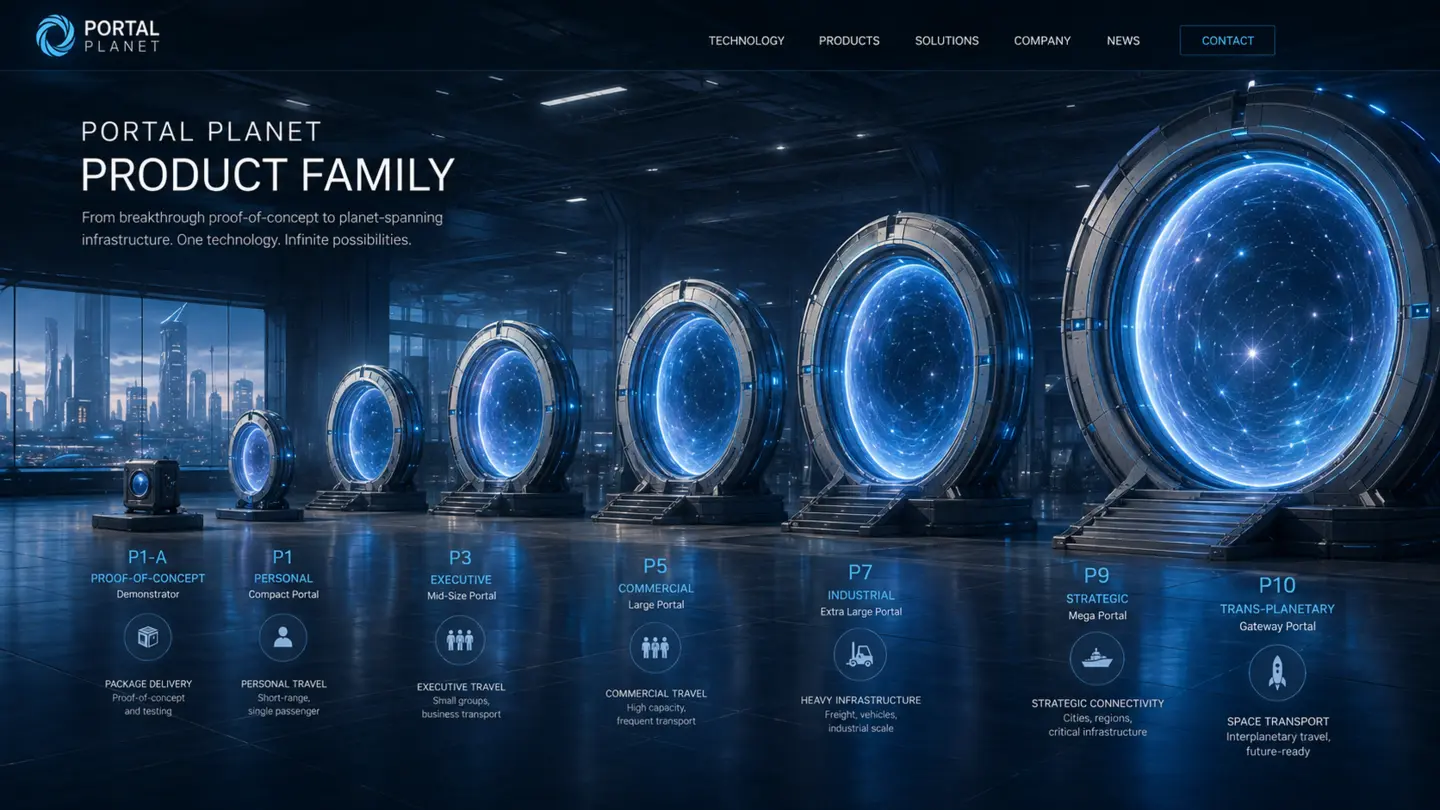
Portal product family
One platform family, deliberately divided by scale, environment, risk, and public purpose. The numbering describes a development ladder—not a promise that every class is technically achievable.
← Back to Portal PlanetStaged program logic
Portal Planet avoids the false simplicity of one device serving every mission. Smaller classes emphasize proof, inspection, and controlled access; larger classes add passenger, freight, vehicle, and strategic capacity.
Bench, laboratory, and secure local-transfer concepts intended to produce evidence before public deployment.
Controlled movement within campuses, hospitals, industrial sites, and emergency networks.
Human-scale public gates with accessibility, identity, screening, and terminal operations.
Higher-capacity logistics for cargo, emergency response, and industrial infrastructure.
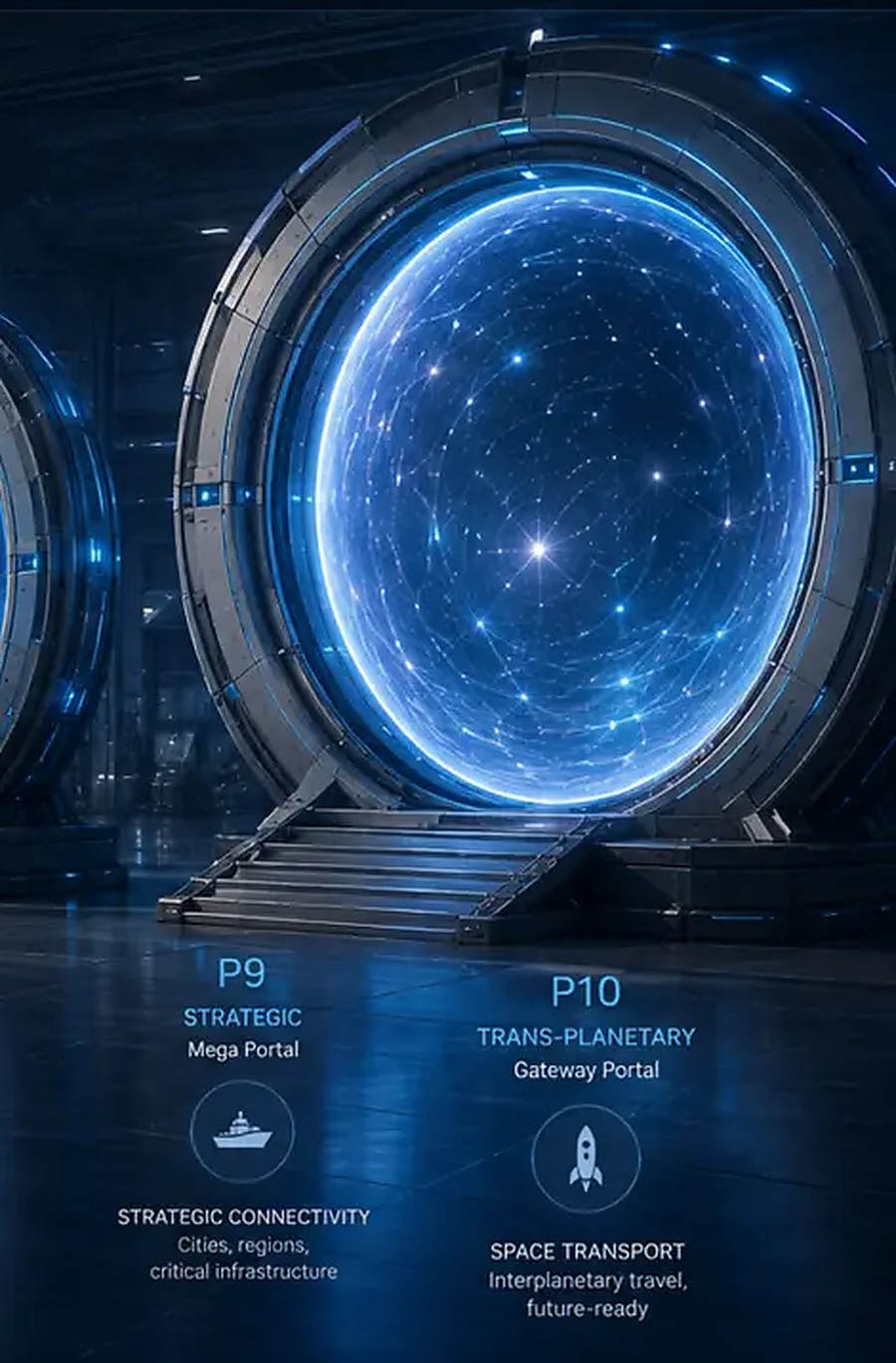
P10 strategic horizon
P10 describes a future large-scale system for strategic infrastructure and off-world operations. It is intentionally separated from early terrestrial classes so speculation does not blur with near-term validation.
Global transition scenario
Even if safe portal transport had already been proven, replacing a major share of global travel would still demand a multi-generation buildout. The range is deliberately broad and should not be read as a prediction.
Build paired terminals, power, data, local feeders, and maintenance capacity before expanding routes.
Safety certification, cross-border travel, privacy, land rights, and responsibility require durable agreements.
Investment would likely reach global infrastructure scale while workers and industries adapt over decades.
Rail, roads, aviation, and ports remain necessary backups and feeders, with selective repurposing over time.
Public boundary
This page communicates the family logic and intended uses. Dimensions, field methods, tolerances, control laws, and patent-sensitive implementation concepts remain unpublished.